Agentic grocery shopping, on your real account.
Grocey is a supermarket API for AI shopping agents: sign in once to a real grocery account and get back real order history, real delivery addresses and slots, and a cart it can actually fill, not a public catalog to browse.
I want to cook carbonara and tomato soup this week, plus my usual items
Carbonara for four needs spaghetti, guanciale, eggs and pecorino; tomato soup needs canned tomatoes, onion, garlic and stock. Here's what Grocey found and filled at your store, plus your usual repeat items:
This week's meals
- Spaghetti, 500 g 5.49 PLN
- Guanciale, 150 g 12.99 PLN
- Pecorino Romano, 200 g 14.50 PLN
- Chopped tomatoes, tin, 400 g × 2 6.58 PLN
Your usual, from repeat orders
- Oat drink, barista, 1 L 8.99 PLN
- Wholemeal sourdough loaf 7.49 PLN
Cart filled for the week, delivery slot held. You tap buy at Delio to place it.
Real field names from the groceries contract (GroceryCart, GroceryLine, GroceryFulfilmentSlot, topProducts). Example values, not a captured account.
What did I order last time from Delio? Reorder it
Your last Delio order: 7 items, 69.93 PLN. Grocey re-added every line to a fresh cart:
Delio, Warszawa · 7 items · 69.93 PLN
Reordered from last time
- Oat drink, barista, 1 L × 2 17.98 PLN
- Wholemeal sourdough loaf 7.49 PLN
- Free-range eggs, 10-pack 11.99 PLN
- Butter, 200 g 8.99 PLN
- Bananas, 1 kg 4.49 PLN
- Coffee, ground, 250 g 18.99 PLN
Same order, refilled in your cart, delivery slot held. You tap buy at Delio to place it.
Real field names from the groceries contract (GroceryCart, GroceryLine, GroceryFulfilmentSlot, topProducts). Example values, not a captured account.
Add ingredients for this, for 4 people, to this week's groceries
That's a baked ziti with a side salad, portioned here for four. Grocey matched the ingredients at your store:
For 4: baked ziti and salad
- Ziti pasta, 500 g 5.99 PLN
- Marinara sauce, 700 g jar × 2 13.98 PLN
- Mozzarella, shredded, 200 g × 2 17.98 PLN
- Ricotta, 250 g 9.99 PLN
- Salad greens, 150 g bag 6.49 PLN
Cart filled for four, delivery slot held. You tap buy at Delio to place it.
Real field names from the groceries contract (GroceryCart, GroceryLine, GroceryFulfilmentSlot, topProducts). Example values, not a captured account.
Why an account, not a catalog
Sees your account. Not a public catalog.
A catalog API can list what a store sells. It was never signed in to your account, so here is what it cannot see, and what Grocey reads instead.
Order history
A catalog API has no account to read, so it has no order history either. Grocey signs in to your real account and reads what you actually bought, when, and for how much.
Addresses and delivery slots
A catalog API can only guess at delivery. Grocey reads your real saved addresses and the delivery slots your account actually sees today, not a generic estimate.
A live cart
A catalog API hands you a product list and leaves you to rebuild the cart yourself. Grocey fills a real cart on your real account, ready for you to check out with one tap.
Your account, not a snapshot
A catalog API shows the same product list to everyone. Grocey reads whatever your account actually sees: stock, prices, and slots as they exist for you.
Consumer products
Grocey where you already are.
Connect your own assistant today. Grocey Chat, a standing shopping agent of its own, is next.
End users
Connect to Claude or ChatGPT
One URL turns Grocey into a tool your assistant can call: search a store, check your cart, ask what is in your delivery slot today.
Set it up →Meal planning
AI meal planning to a real basket
Plan the week, then fill a real cart at a real store from the plan. The meal plan is AI, the basket is your actual account.
See how it works →Grocey Chat
A standing shopping agent on iMessage. Not built yet.
For builders
Build directly on the API.
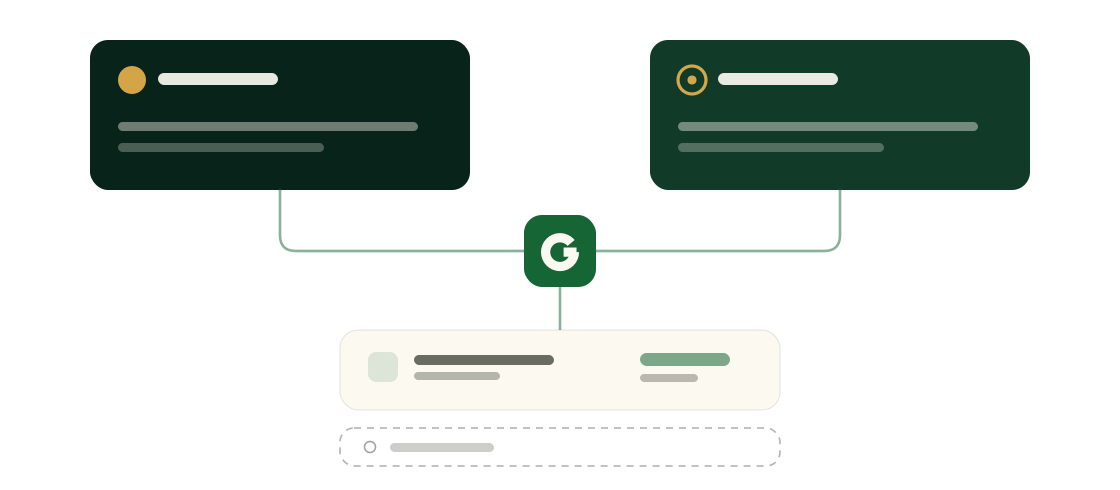
Two APIs, kept separate from the two consumer doors above: the write API that acts on someone's own account, and the catalogue it reads along the way.
Builders
Build on the write API
Signed API keys, connect links, and webhooks over MCP or REST. One contract, and every provider implements it the same way.
Read the docs →Builders
Supermarkets Catalog API
Read the crawled catalogue behind a store Grocey supports: product names, prices in minor units, availability, images and categories, from the live site rather than a syndicated feed. Paginated, and bounded to the stores Grocey crawls today.
See the endpoints →Coverage · live data
What's live today, and where to read more.
Generated at build time from the exact same provider declarations the API reads: never fetched live, never a second list to let drift from the truth. Each provider links to its own page below.
BE · 1 provider

LU · 1 provider
Poland · 4 providers
 Delio Live
 Polish grocery delivery. Sign in with your phone number and an SMS code.
 Frisco.pl Building
 Polish online supermarket with van delivery. Sign in with your e-mail and password.
 Żabka Jush Building
 Żabka's express grocery delivery in Poland. Same account and sign-in as Delio.
 Mamyito Building
 Warsaw grocery delivery. Sign in with the e-mail address and password you use on mamyito.pl.
Roadmap · not built yet
Named honestly, not shipped yet.
These are not in the capability cards above because they are not real yet. When they ship, they move up.
Checkout
Grocey fills the cart. Placing the order is still a human tap today. A checkout method exists in the contract, but it's switched off by default, and nothing has placed a real order through it yet.
Invoicing
Pulling a receipt or an invoice out of a completed order is not built yet.
Calendar sync
Putting a delivery slot on a calendar automatically is not built yet.
Nutrition data
Per item nutrition data alongside search results is not built yet.
FAQ
The questions everyone asks.
Is the developer API live yet?
Not for self-serve signup. Grocey already runs in production as the connector behind Alfredo, our own concierge agent. The gro_* keys, connect links, and webhooks described on this site are the interface we're building toward. Request access to be part of private beta.
Which providers actually work today?
Delio, in Poland, is the only provider that has ever completed a real connect. Collect&Go, Frisco.pl, Żabka Jush and Mamyito are built and unit-tested, but none of them has ever connected to a real account, so we label them honestly instead of counting them as coverage.
What does Try now actually do?
It takes you to your Grocey dashboard. Sign in with Google or a one time code we email you, then connect your own store and see what Grocey can see: your recent orders, your addresses, your cart. It is a live demonstration of the account level read, not a signup for the developer API.
How does Grocey connect without a partner API?
It drives the real grocery site in an isolated browser session, the same way a person would sign in by hand: no scraping shortcuts, no shared credentials, no partnership required.
What can I actually call today?
Search, store and fulfilment options, and, where the provider supports it, order history and a live, editable cart. Where a provider genuinely can't answer something, the API says so explicitly rather than returning an empty result that looks like a fact about the account.
See your own account, not a demo account.
Sign in with Google or a one time email code, connect your own store, and see what Grocey reads back. Building something on top of it? Request access to the developer API.